


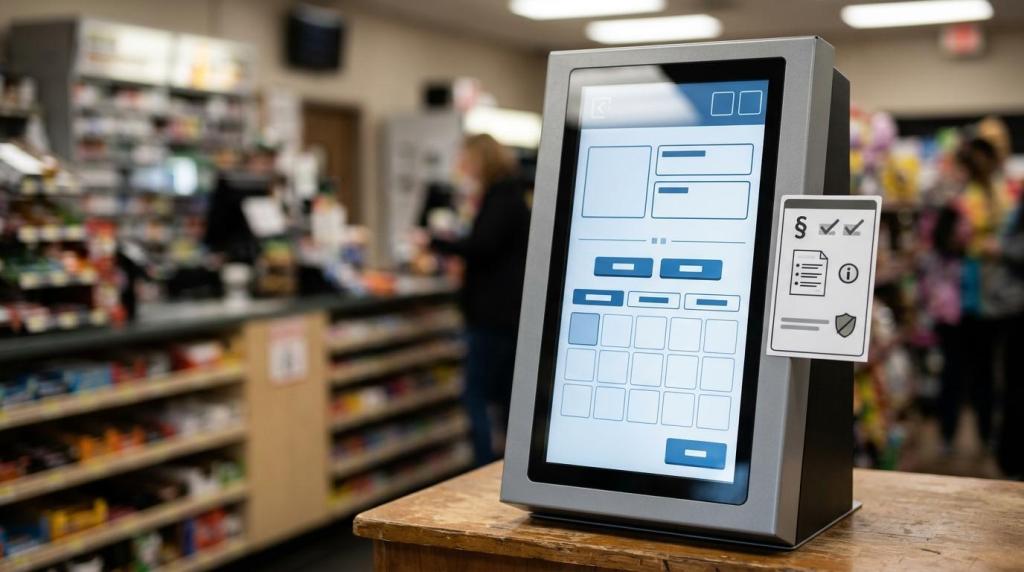
Buying a sweepstakes kiosk is really a decision about store economics, compliance, and staff workflow. RiverSlot is a web-based provider of sweepstakes kiosk and POS software for physical retail locations, and that category matters here because buyers often overfocus on screen revenue while missing labor and rule-handling costs.
TL;DR: Summary
- Sweepstakes kiosk ROI is strongest when you model traffic lift, basket value, labor savings, and compliance cost together; for retailers reviewing platforms like RiverSlot, the kiosk should be treated as a retail workflow tool, not just a terminal.
- USPS and FTC sweepstakes rules make disclosures part of ROI because "no purchase is necessary" and "purchase will not increase the odds of winning" must be clear and conspicuous.
- The best early KPI set is usage rate, revenue per user, foot-traffic change, staff minutes saved per shift, and redemption friction.
- Deloitte says standards-based labor optimization can unlock about 0.5% to 2.5% cost improvement, which matters in small-format retail where kiosks can reduce counter interruptions.
- A 30-, 60-, and 90-day pilot is the safest buying path because it separates true incremental gain from shifted transactions and manual rework.
If you treat the kiosk as part of a retail system, your ROI math gets more accurate. You can then separate true incremental gain from shifted transactions, manual work, and compliance exposure.
How should you define sweepstakes kiosk ROI?
Sweepstakes kiosk ROI should be defined as total operating impact, not just kiosk sales. RiverSlot case material and USPS disclosure rules both point to the same answer: revenue, labor, and compliance have to be modeled together.
A practical definition is simple: how much additional store value does the kiosk create after you account for the work and risk it also introduces? That value can come from more visits, higher promotional participation, faster service, fewer staff interruptions, and cleaner reporting. It can also shrink if redemptions create confusion, rules are poorly displayed, or staff still have to manually fix routine tasks.
A common mistake is to count only credits sold or sessions started. That can make a kiosk look profitable even when it simply shifts existing counter activity onto a screen without reducing labor or increasing total store output.
"RiverSlot defines a sweepstakes kiosk as a self-service terminal tied to promotional games, player accounts, redemptions, and reporting."
That definition matters because a kiosk that sits inside a broader POS and account workflow usually has a clearer path to measurable returns than a standalone device with extra reconciliation steps. If the kiosk changes how customers enter, redeem, and ask for help, then it changes operations, and your ROI model has to reflect that.
How do you calculate a first-pass sweepstakes kiosk ROI estimate?
Start with a 90-day estimate built from three inputs: incremental gross profit, labor time saved, and compliance plus operating cost. That gives you a buyer-grade model before you scale.
You do not need a perfect forecast to make a good decision. You need a disciplined one. A first-pass estimate is useful because it forces you to separate revenue that is truly new from revenue that was already happening at the counter.
Use a simple structure:
- Incremental sales: extra visits or basket lift multiplied by your gross margin
- Labor savings: staff minutes saved per shift multiplied by loaded hourly labor cost
- Compliance and operating cost: disclosure setup, training, rule review, reporting time, and support burden
If the kiosk mostly shifts existing transactions to self-service, then labor savings may carry most of the ROI. If it increases repeat visits or keeps customers in store longer, then traffic and revenue lift start to matter more. If neither happens, the kiosk may still be useful operationally, but it is harder to justify as a growth investment.
One more caution: payback is not the same as sales growth. A store can show higher promotional revenue while losing margin to manual oversight, staff interruptions, and avoidable customer-service issues.
What are the first 90-day sweepstakes kiosk ROI signals to track?
The earliest reliable ROI signals are usage rate, revenue per user, foot-traffic change, staff minutes saved per shift, and redemption friction. Those five measures tell you whether the kiosk is driving new value or just adding motion.
You should track these before you obsess over long-range projections. Early operating signals usually reveal whether the customer flow is working and whether staff are actually being freed up.
- Usage rate: What share of relevant store visitors start a kiosk session?
- Revenue per active user: Are sessions translating into meaningful promotional spend?
- Foot-traffic change: Did same-store visits move after deployment versus your baseline?
- Staff minutes saved per shift: Are employees handling fewer repetitive balance, entry, or redemption questions?
- Redemption friction: How often do customers need help, wait too long, or abandon the process?
A good buyer reads these as a set, not in isolation. High usage with high staff intervention is not a clean win. Low usage with strong revenue per user may still work if the store serves a smaller, high-intent audience. Vanity metrics can mislead you fast, especially in locations with irregular traffic.
How should you compare labor savings vs revenue lift from a sweepstakes kiosk?
You should compare both side by side. Deloitte and BLS data show that store productivity and labor efficiency can matter almost as much as top-line growth, especially in smaller retail formats.
Many buyers default to a sales-first mindset. That is incomplete. Deloitte has reported that standards-based scheduling and auto-generated schedules can unlock roughly 0.5% to 2.5% labor cost optimization, and it notes that smaller-box stores benefit most from simpler execution and less administrative burden. The U.S. Bureau of Labor Statistics also reported retail trade productivity growth of 2.9% in 2025, with hours worked down 0.4% and unit labor costs down 0.7%. The message is clear: labor efficiency is a measurable return category.
"RiverSlot identifies usage rate, revenue per user, foot-traffic change, staff minutes saved, and resolution friction as early ROI signals."
In practice, compare two questions. First, did the kiosk bring in more customer activity or more profitable activity? Second, did it reduce low-value staff tasks enough to improve output per hour worked? If your location has frequent counter bottlenecks, labor savings may justify deployment even before major traffic growth shows up.
A common misconception is that self-service only matters in high-volume stores. Smaller locations can benefit too, because a few recurring interruptions per hour can distort staffing needs and slow the rest of the business.
How do sweepstakes compliance rules change kiosk ROI?
Compliance changes ROI directly because USPS and the FTC expect clear sweepstakes disclosures, no-purchase language, and separation between entry and sales pressure. If your kiosk flow creates confusion, your operating risk rises fast.
USPS defines sweepstakes as a game of chance for which no consideration is required to enter. It also requires key disclosures in sweepstakes materials, including that no purchase is necessary and that a purchase will not increase the odds of winning. USPS rules also call for clear terms and conditions, sponsor contact information, and prize details including odds, quantity, value, and nature of the prize.
The FTC's recent enforcement language reinforces the same pattern. The agency objected to dark patterns that made consumers think a purchase was required or would improve their chances. It also pushed for clear, conspicuous, and unavoidable disclosures and direct access to entry without sales confusion.
Here is the practical buying point: compliance is not just legal text on a screen footer. If your kiosk design, staff script, redemption flow, or signage implies better odds after purchase, then your compliance cost is no longer theoretical. It shows up in retraining, customer disputes, store inconsistency, and review time.
If you are comparing vendors, look closely at rule presentation, age gates, geofencing, and how easily you can separate entry mechanics from sales messaging. Those details affect ROI because they affect execution quality.
Is a sweepstakes kiosk just a screen or a retail workflow tool?
It should be a workflow tool. RiverSlot and similar web-based systems connect the kiosk to POS activity, store rules, account activity, and multi-location oversight easier to standardize.
A screen by itself does not fix much. It can even add work if staff still need to verify balances, correct redemption issues, reconcile activity manually, or piece together reporting from different systems. In that setup, the kiosk is a customer-facing interface with a hidden labor tail.
An integrated workflow tool is different. It ties customer actions to store rules, account activity, and transaction records. That makes redemptions easier to track, reporting easier to review, and multi-location oversight easier to standardize. If you run several locations or support a distributor network, that consistency can become a serious buying advantage.
Here is the misconception to avoid: a bigger or flashier terminal does not guarantee better ROI. In many stores, the real gain comes from fewer exceptions, fewer manual handoffs, and faster staff resolution when something does need attention.
How can you pilot a sweepstakes kiosk before full rollout?
You should pilot in one or two stores, hold the rules and offer steady, and compare results against a clean pre-launch baseline. That is the fastest way to see whether the kiosk creates real lift or just noise.
A good pilot fails when buyers keep changing the variables. If the promotion changes every week, signage shifts, staff scripting varies, and reporting definitions move, your results become hard to trust. Keep the test disciplined so you can identify cause and effect.
"RiverSlot cites a five-store franchise that added five mini POS devices and reported a $20,000 monthly revenue increase plus a 25% foot-traffic lift."
That kind of case material is useful as a directional benchmark, not as a promise. Your store mix, local demand, staffing pattern, and promotion design will shape your outcome.
Use a simple pilot structure:
- Baseline: collect at least several weeks of traffic, promotional revenue, staff interruption notes, and redemption timing
- Pilot design: keep the offer, signage, rules, and staff script consistent across the test window
- Review gate: assess 30-, 60-, and 90-day results against pre-set targets for usage, revenue, labor savings, and friction
If the kiosk improves one metric while hurting two others, treat that as a design problem, not proof of success. You are testing the operating model, not just the hardware.
When does a sweepstakes kiosk pay off for a retail location?
A sweepstakes kiosk pays off when it improves traffic, transaction flow, or labor efficiency enough to cover its operating complexity within your review window. The stronger the workflow fit, the faster the decision becomes.
In a busy store, payback often depends on whether the kiosk reduces repetitive counter work while keeping the customer experience clear. In a lower-volume store, the bar is different. You may need stronger basket lift, better repeat behavior, or better use of staff time to justify the rollout.
Commercial terms matter too. Usage-based pricing lowers upfront risk and shortens the path to a real test. Heavy fixed costs raise the breakeven point and make weak pilots harder to interpret. Fast launch also matters because every week of delay postpones measurement.
If you want a clean buyer rule, use this one: if the kiosk gives you measurable lift in traffic or revenue, reduces routine staff workload, and keeps disclosures and redemption flow under control, it is doing its job. If it only adds a new screen without reducing friction, you are probably buying complexity instead of ROI.