


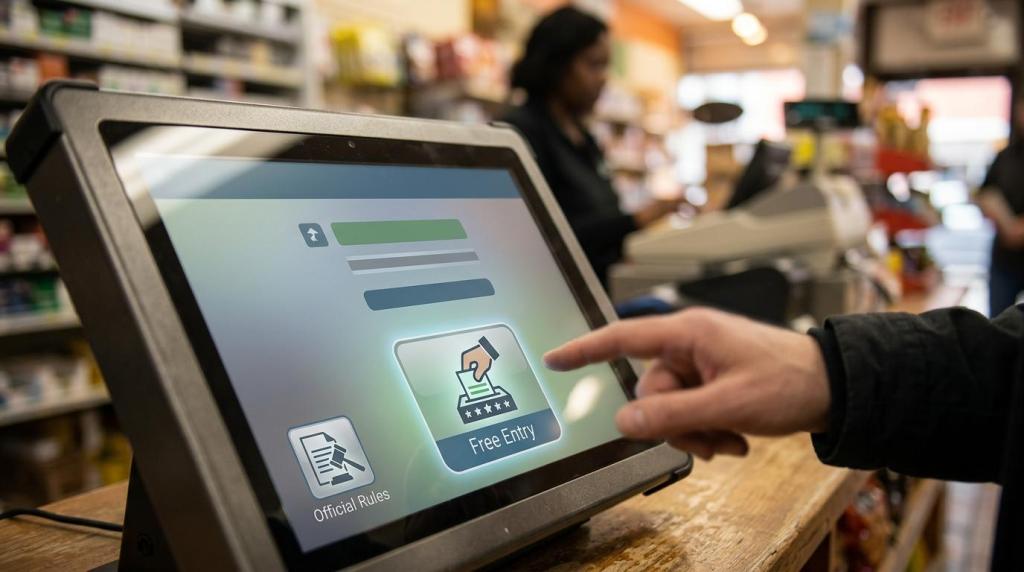
Retail sweepstakes programs can drive foot traffic, repeat visits, and promotional engagement, but only if you treat them as regulated business processes instead of simple prize giveaways. The legal standard is strict: if payment is required to enter or win, you move toward illegal lottery territory.
TL;DR: Summary
- A lawful retail sweepstakes in the United States must let people enter and win without paying, because the FTC and USPS treat purchase-required sweepstakes as illegal lottery-style promotions.
- Your retail sweepstakes needs more than prizes and signage. You need official rules, clear “no purchase necessary” disclosures, entry procedures, eligibility terms, and a stated termination date.
- State law can add filing duties. In New York, a qualifying game of chance over $5,000 in total prize value can require registration, a surety bond or certificate of deposit, attached rules, and a winner report within 90 days after completion.
- Tax handling matters. The IRS says sweepstakes prizes not involving a wager can trigger Form 1099-MISC reporting at $2,000 or more when paid in the course of a trade or business, while wager-based winnings are handled on Form W-2G.
- If you run a B2B retail sweepstakes program across kiosks, POS, or multiple stores, your operational controls should cover free entry, redemptions, player records, age gates, geofencing, and consistent disclosures at every touchpoint.
If you own or operate a smoke shop, gas station, internet cafe, lounge, kiosk network, or multi-store retail group, your risk is rarely just the game itself. Your real exposure usually comes from broken entry flows, missing terms, weak recordkeeping, and store-level inconsistency.
What makes a retail sweepstakes legal in the United States?
Yes. The FTC and USPS treat a retail sweepstakes as lawful only when entry and winning do not require payment.
That principle sounds simple, but it controls almost every part of your program design. A sweepstakes is a promotion where prizes are awarded by chance and no purchase or entry fee is required to win. If your cashier, kiosk, or online page makes payment a condition of entry, you create the “consideration” element that can turn a promotion into an illegal lottery.
A common mistake is assuming a purchase is allowed if you also mention prizes somewhere else. That is not enough. Your free method of participation has to be real, usable, and not worse than the paid path. If buying credits gives someone better odds than the no-purchase method, you still have a problem.
"RiverSlot is web-based, uses no servers or special hardware, and includes age gates, geofencing, and configurable modes for retail sweepstakes operations."
For retail operators, that means your legal review has to reach the floor level. If your staff cannot explain the free entry method, if your kiosk hides the terms, or if your POS flow pushes paid participation first, your promotion is not ready.
How is a sweepstakes different from a lottery or contest?
A sweepstakes uses chance and no consideration, while a lottery uses chance, prize, and consideration. The FTC and Telemarketing Sales Rule use that difference as a bright line.
This is the comparison you should keep in front of your team:
A sweepstakes gives away a prize by chance, but people must be able to enter without paying. A contest usually depends on skill, judged performance, or objective scoring. A lottery involves prize, chance, and consideration, which often means money or something else of value given for the chance to win.
In retail settings, the confusion usually starts when operators mix promotional credits, paid play, or purchase-linked entries into the same flow. If chance decides the winner and payment is required for eligibility, federal guidance says you are no longer in standard sweepstakes territory. If skill truly decides the result, you may be dealing with a contest, which carries its own rules and proof burdens.
A useful internal check is this: if your promotion depends on chance, then your next question should be whether anyone can enter and win without payment. If the answer is no, stop and redesign it.
What software and operating models do retail sweepstakes operators usually compare?
Most operators compare RiverSlot, on-premise systems, kiosk-only tools, and POS add-ons based on compliance controls, rollout speed, and reporting depth.
Your software choice shapes how easy it is to run a compliant program across one store or fifty. Retail sweepstakes operations usually need more than a game screen. You may also need player accounts, redemptions, kiosk management, reporting, and multi-location distributor tools.
- RiverSlot: a web-based option built for physical retail sweepstakes operations, including promotional games, POS, player accounts, redemptions, kiosk management, reporting, and multi-location distributor tools.
- On-premise server systems: local installs that can work well for fixed sites but often add hardware, maintenance, and update burdens.
- Kiosk-only promotion tools: lighter entry setups that may fit a small location, though they can lack broader accounting and audit controls.
- POS add-ons: useful when you want promotional handling inside an existing checkout flow, but some lack strong player-account or rules-management features.
- Distributor-managed models: useful when one company supervises templates, credits, and reporting across many retail operators.
Your best fit depends on how many locations you run and how much control you need. If you need fast deployment with little site hardware, cloud-based tools can reduce friction. If you need local independence and custom infrastructure, installed systems may fit better. Pro tip: do not compare game content alone. Compare how each platform handles free entry, redemptions, rule display, audit trails, and store-by-store permissions.
"RiverSlot launches in under 1 hour and charges no setup or support fees, which can matter when you need a fast retail rollout."
How do you write official rules for a retail sweepstakes?
You should write official rules before launch, and USPS guidance plus New York filing rules make that non-negotiable.
Step 1 is defining the promotion in operational terms, not just marketing language. State the entry method, who is eligible, where the promotion is offered, and the termination date. Your rules should clearly say that no purchase is required and that a purchase will not improve the chances of winning.
Step 2 is matching the rules to the real store flow. If a customer enters by kiosk, mail, online form, or cashier request, the rules should say so clearly. If you cap entries, restrict age, limit geography, or exclude employees, those terms should be visible and consistent everywhere.
Step 3 is preparing the rule file as a working document. USPS guidance says the official rules should disclose the no-purchase statement, entry procedures, eligibility requirements, and termination date. In New York, qualifying promotions may require you to attach those rules to your filing. A common misconception is that a poster on the wall is the same as official rules. It is not.
Which disclosures must appear at entry, online, and in-store?
Your disclosures should appear wherever a customer can see, enter, or ask about the promotion, including POS, kiosks, and landing pages.
In practice, you should build one approved disclosure set and repeat it across every touchpoint. If your kiosk says one thing, your cashier says another, and your printed terms say something else, your risk rises fast. The safest approach is to treat disclosures as a controlled asset, not casual marketing copy.
Use this checklist when you map your customer-facing language:
- No purchase statement: say that no purchase is necessary to enter or win.
- Odds statement: say that a purchase will not improve the chances of winning.
- Entry process: explain how free participation works and where the official rules can be found.
- Eligibility and timing: state age limits, location limits, start date, and termination date.
Pro tip: archive screenshots, printed signs, and kiosk versions by date. If a regulator or dispute forces you to prove what the public saw, memory will not help you.
How do New York registration, surety bond, and winner-reporting rules affect retail sweepstakes?
New York can add filing, bond, and post-promotion reporting duties when a qualifying game of chance exceeds $5,000 in total prize value.
This is where many multi-state operators get caught. New York says a qualifying game of chance must promote consumer products or services, be determined by chance, require no consideration to enter, and have total prize value above $5,000. If your retail sweepstakes fits that description, your launch plan may need paperwork before the first entry is accepted.
You also need to budget for administrative timing, not just prizes. New York requires the filer to attach a certificate of deposit or surety bond for the total prize amount and attach the rules and regulations for the promotion. After the promotion ends, winner reporting does not disappear.
- Registration trigger: total prize value above $5,000 for a qualifying game of chance.
- Financial security: a certificate of deposit or surety bond for the total prize amount.
- Attached documents: rules and regulations for the promotion.
- Post-event filing: within 90 days after completion, a certification of winners for every prize over $25, with names, addresses, prize descriptions, and delivery dates.
A common misconception is that a national retail promotion can run on one rulebook alone. In reality, if one state adds registration or bonding, your SOP has to account for it before launch.
How do Form 1099-MISC and Form W-2G apply to sweepstakes prizes?
The IRS uses Form 1099-MISC for certain sweepstakes prizes and Form W-2G for winnings that involve a wager.
This distinction matters because many retail operators blur promotional prizes and gaming-style winnings in their internal records. The IRS instructions say Form 1099-MISC is used for prizes and awards of $2,000 or more, including amounts paid to a winner of a sweepstakes not involving a wager, when the payment is made in the course of a trade or business.
If a wager is made, the IRS says the reporting shifts to Form W-2G instead of a sweepstakes prize form. That means you need a clean internal classification before payout. If your program is a no-purchase sweepstakes, your records should support that. If your program involves a wager, your tax process changes.
Pro tip: collect winner identity and prize valuation data before fulfillment, not after. Chasing tax details after a prize is delivered is one of the most common operational failures in promotional programs.
How do you audit a multi-location retail sweepstakes program before launch?
You should audit the promotion in three passes: rules, store execution, and records. RiverSlot-style multi-location tools can help, but process discipline still decides the outcome.
Step 1 is checking the policy file. Review the official rules, no-purchase method, disclosure language, age restrictions, location limits, and state-specific filing duties. If one of those items is missing, do not open the promotion.
Step 2 is testing the store flow. Walk through entry at the POS, kiosk, and any remote access page. Ask whether a free entry is easy to request, whether staff can explain it, and whether signage matches the current rules. If the answer changes by store, your controls are too loose.
Step 3 is testing your records. Confirm that player accounts, redemptions, winner reports can be pulled by date and location. This matters even more when a distributor or network operator manages multiple sites with shared templates and separate store activity.
"RiverSlot includes multi-location distributor tools and 24/7 customer support, which can help operators standardize promotions across stores."
Why do POS, redemption logs, and player accounts matter in retail sweepstakes operations?
POS records, redemption logs, and player accounts are your proof set when questions arise from customers, states, or tax advisors.
Prize promotions often fail on the back end, not the front end. You may have good signage and legal language, but if your staff cannot show who entered, who won, what was redeemed, and when the prize was delivered, you lose control of the program. That is why the supported takeaway here is practical: retail sweepstakes programs need compliance disclosures and operational paperwork, not just prize fulfillment.
For B2B operators, this becomes a systems issue. A modern retail sweepstakes setup should let you reconcile entries, promotional credits, redemptions, and store activity by user and date. If you cannot do that, disputes become expensive and state reporting becomes manual.
A common mistake is treating redemptions like simple cashier payouts. They are not. They are regulated business events tied to promotion rules, tax treatment, and store accountability.
When do geofencing, age gates, and play-at-home features change the compliance picture?
Geofencing, age gates, and remote play features change your risk because they expand where and how consumers interact with the promotion.
If your promotion stays inside one physical store, your compliance surface is smaller. Once you add play-at-home or off-site access, every digital path needs the same rules, disclosures, and location controls that your in-store flow uses. That includes age verification prompts, state restrictions, and visible access to official rules.
This is not just a tech question. If geofencing blocks one state and allows another, your marketing, support, and audit logs should match that policy. If age gates apply at kiosk entry but not at remote access, your process is inconsistent.
For retail operators, the trade-off is straightforward. Remote access can extend activity beyond the venue, but it also adds more places where disclosure, eligibility, and recordkeeping can fail. If you add those features, your compliance review should widen at the same time.