


If you run promotional games across retail locations, 2026 is not the year to rely on old assumptions about sweepstakes compliance.
State law is moving in two directions at once. Some states still allow carefully structured promotional sweepstakes. Others are drawing a harder line between lawful advertising and activity they view as gambling. If you operate internet cafes, fish game rooms, kiosks, smoke shops, convenience stores, or multi-location networks, that difference affects your software setup, your rules, your signage, and even which states you should avoid entirely.
The practical takeaway is simple: you need a state-by-state compliance model, not a one-size-fits-all promotion.
Why state-by-state sweepstakes compliance matters in 2026
A legal sweepstakes generally depends on removing the element of payment or other required value from participation. That sounds straightforward until you compare states. One state may focus on disclosure language. Another may focus on whether the promotion is tied to a sale. Another may treat the same format as an unauthorized gambling product, even if it is marketed as a sweepstakes.
That is why operators need to think beyond the word "sweepstakes." Regulators often care much more about how the promotion works than what it is called. Entry methods, payment flows, free entry access, redemption mechanics, online access, and prize messaging all affect the legal analysis.
If you manage more than one location, the risk grows fast. A format that is workable in one jurisdiction can create immediate exposure in another. In 2026, your safest path is to review each state on two levels:
- Disclosure rules: What must appear in the official rules, entry form, or solicitation materials?
- Gambling classification: Could the promotion be treated as a lottery, unauthorized contest of chance, or online gaming activity?
- Free entry access
- Prize value transparency
- Channel restrictions for online play
The core legal test behind most sweepstakes rules
At a high level, sweepstakes law still revolves around three familiar concepts: prize, chance, and consideration. If your promotion includes a prize awarded by chance and requires payment or something similar to participate, many regulators will view that as an illegal lottery unless a specific exception applies.
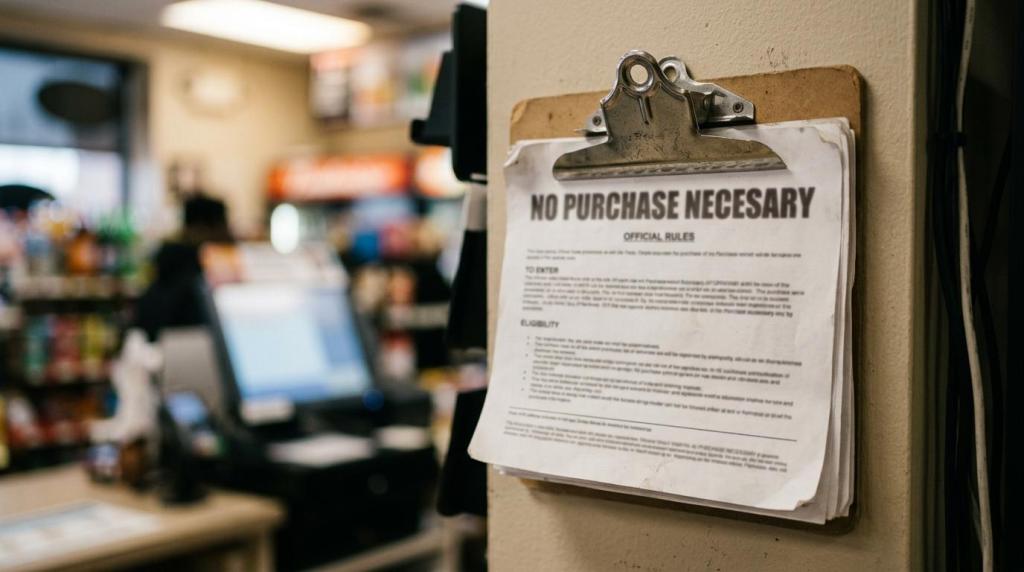
That is why "no purchase necessary" is not just a marketing phrase. It is part of the legal structure. Federal guidance, including USPS materials, also reflects the standard distinction: a sweepstakes awards prizes by chance without requiring a purchase or entry fee, while a lottery includes payment.
In practice, consideration can be broader than cash. States may look at whether a participant had to buy something, pay a fee, make a deposit, or provide another form of value to enter. If your business model uses credits, kiosks, promotional bundles, or linked purchases, you should assume regulators will examine the full customer flow, not just the wording on a sign.
One weak point shows up often in retail promotions: a free entry path exists on paper, but the paid path is much easier, more visible, or more common. That kind of imbalance can invite scrutiny.
California sweepstakes laws in 2026
California is one of the most important states to watch because it now presents two separate compliance issues.
First, California has long required specific disclosures in sweepstakes solicitation materials and official rules. A clear and conspicuous no-purchase-or-payment-necessary message must appear in the official rules or on the entry-order device. The message must be printed in capital letters, in contrasting typeface, and at least as large as the largest type in the official rules. California also requires the official rules to disclose the date or dates when the final winner or winners will be determined.
Second, California’s 2026 law takes a much tougher approach to online sweepstakes games. The state makes it unlawful to operate, conduct, or offer an online sweepstakes game in California. The law also reaches supporting parties that knowingly and willfully assist those operations, including payment processors, geolocation providers, content suppliers, platform providers, and media affiliates.
There is an important carveout, but it is narrow. California preserves limited and occasional promotional sweepstakes used as advertising or marketing for bona fide consumer sales, so long as they are not intended to create ongoing gambling or gaming activity.
That means your California review should ask more than, "Do we have rules?" It should ask whether the promotion is occasional, tied to a real consumer sale, and clearly distinct from an ongoing gaming product.
Washington sweepstakes laws in 2026
Washington remains one of the stricter states for businesses using sweepstakes-style products.
The Washington State Gambling Commission has stated that many of the "sweepstakes" products used by businesses combine elements of legal gambling activities into a contest that is not authorized in Washington. The state also says that a promotional contest of chance may use free tickets only and may not charge consideration for those tickets.
That language matters because Washington often looks past branding and reviews the actual mechanics. If a system includes paid entries, bundled access, or other forms of required value, the state may see it as unauthorized gambling rather than a lawful promotion.
Washington also has a disclosure regime under its Promotional Advertising of Prizes Act. Promoters must provide disclosures in the mailing, rules, and entry form, and those disclosures must be easy to find, read, and understand.
If you operate in Washington, conservative structuring is the smart move. Promotions should be simple, free to enter, and clearly separated from any activity that looks like paid gaming.
Idaho sweepstakes laws in 2026
Idaho takes a direct approach that many operators underestimate.
According to the Idaho Attorney General’s consumer protection guidance, prize promotions are unlawful if they require any kind of purchase or similar payment to participate. Idaho also warns that prize promotions and sweepstakes offers cannot be deceptive or misleading about winning odds or prize value, even when no purchase is required.
That gives you two compliance priorities in Idaho: no required payment, and no inflated or confusing prize claims.
For location operators, this is especially relevant when promotions are attached to store purchases, points, digital credits, or sweepstakes access tied to another transaction. If participation depends on the transaction in any meaningful way, you should treat Idaho as a high-risk jurisdiction.
2026 state sweepstakes comparison for operators
A side-by-side view helps you spot where policy differences can reshape your rollout plan.
| State | Main 2026 Issue | What You Should Check | Practical Risk Level |
|---|---|---|---|
| California | Strict disclosure rules plus ban on online sweepstakes games | Official rules formatting, no-purchase message, winner date disclosure, whether the promotion is only limited and occasional | High |
| Washington | Many sweepstakes-style gaming products treated as unauthorized gambling | Whether any consideration is involved, whether the format resembles a contest of chance tied to paid activity, disclosure clarity | High |
| Idaho | Purchase or similar payment can make the promotion unlawful | Entry method, payment connection, accuracy of odds and prize claims | Medium to High |
| Other states | Varying disclosure, consumer protection, and gambling laws | State-specific legal review before launch | Variable |
This table is a planning tool, not legal advice. The point is to help you sort states by operational difficulty before you commit marketing dollars, software configuration time, or distributor support.
Official rules and disclosure requirements for sweepstakes promotions
Your official rules are not a formality. They are part of the compliance structure.
In California, disclosure formatting is unusually specific. In Washington, disclosures must be easy to find and understand. In Idaho, claims about prizes and chances cannot be misleading. Across states, a weak set of rules can hurt you even if the overall promotion concept is workable.
You should treat official rules as an operating document, not a template you copy from an old campaign.
- Entry terms: Who can enter, how to enter, and whether a free method is available
- No purchase message: Clear language stating that no purchase or payment is necessary and that a purchase does not improve chances of winning
- Winner timing: The date or dates winners will be determined where required
- Eligibility limits
- Prize descriptions
- Odds language
- Redemption terms
For multi-location operators, the rules also need to match what happens in the store. If the signage says one thing, the kiosk says another, and staff explain it a third way, you create risk even before a regulator looks at the game structure itself.
Operational steps for multi-location sweepstakes compliance
You do not fix sweepstakes risk with a single policy memo. You fix it through repeatable controls.
If your business spans several stores or distributor-managed locations, the smartest approach is to build compliance into the platform, the launch checklist, and the daily workflow. That means using tools that control access by state, standardize disclosures, and document the promotion terms in one place.
A workable operating model often includes the following:
- Map each state where you operate or market the promotion.
- Classify each jurisdiction by disclosure burden and gambling risk.
- Disable or restrict formats that do not fit the state’s rules.
- Publish state-appropriate official rules and signage.
- Train staff to explain entry and redemption consistently.
- Audit the promotion after launch, not just before launch.
This is where web-based systems can help. Configurable age gates, geofencing, location-based settings, rule templates, kiosk controls, and centralized reporting give you a better chance of keeping operations consistent across stores. If you rely on manual processes, variation between locations becomes your biggest compliance problem.
How sweepstakes software can reduce state law risk
Software does not make a promotion legal by itself. What it can do is reduce avoidable mistakes.
For B2B operators, that matters because most enforcement risk starts with operational gaps: the wrong version of rules, missing signage, unapproved locations, inconsistent redemption handling, or online access left open where it should be blocked. Those are controllable issues.
A strong system helps you enforce the same standards every time:
- Geofencing controls: Limit access where a state or local market creates higher risk
- Configurable modes: Separate promotional formats by jurisdiction instead of using one default setup
- Centralized reporting: Track entries, redemptions, and promotion activity across locations
- Rule templates
- Kiosk management
- Player account controls
If you support a distributor network, these controls become even more valuable. You need visibility across locations, and you need the ability to restrict or adjust promotions quickly when a state changes course.
Questions to ask before launching a sweepstakes in any state
Before you approve a campaign, your team should slow down and ask a few direct questions.
Does the promotion require any purchase, payment, deposit, or similar value to participate? Is the free entry path real, visible, and equal in practice? Could the format be seen as an online sweepstakes game or unauthorized contest of chance? Do the official rules clearly state the no-purchase terms, winner timing, prize details, and eligibility limits? Are your location settings, kiosk screens, and staff scripts all saying the same thing?
If you cannot answer those questions quickly and confidently, the promotion is probably not ready.
That is not bad news. It is a chance to tighten the structure before launch, protect your locations, and build promotions that can scale with fewer interruptions. In 2026, that kind of discipline is not optional for sweepstakes operators. It is part of running a durable retail program.