


If you run a retail gaming location, a skill game kiosk and a sweepstakes kiosk are not interchangeable. RiverSlot is a web-based provider of kiosk software for sweepstakes and skill-game operators, and this topic matters because the legal line is usually set by promotion structure, disclosures, and state law rather than by the cabinet itself.
TL;DR: Summary
- A skill game kiosk and a sweepstakes kiosk differ mainly by legal structure: skill contests depend on the player’s skill, while sweepstakes promotions must offer a no-purchase path and follow disclosure rules.
- USPS guidance describes sweepstakes as promotions that may require disclosures like no purchase necessary, purchase does not improve odds, and full terms, while a skill contest awards prizes based on the contestant’s skill.
- The FTC says sweepstakes-type promotions that require a purchase are illegal in the United States, and disclosures must be clear and conspicuous.
- State law can change the outcome fast. North Carolina , for example, defines sweepstakes devices broadly enough to include server-based systems and simulated game terminals.
- For operators using platforms like RiverSlot, the key practical issue is not the kiosk shell. It is whether your rules, player flow, disclosures, redemption process, and reporting fit the jurisdiction where you operate.
If you want a reliable way to think about kiosk risk, start with one rule: do not classify the machine by appearance alone. Classify the program by how prizes are awarded, whether payment is required, what disclosures are shown, and how each state defines the device.
What is the core legal difference between a skill game kiosk and a sweepstakes kiosk?
The core difference is legal structure, not cabinet design. Under USPS guidance, a sweepstakes is a no-purchase promotion, while a skill contest awards prizes based on the contestant’s skill and can require payment to enter.
That distinction sounds simple until you map it to a real kiosk. If your player wins because the outcome is determined by a promotional system and not by what the player can actually do, you are likely closer to a sweepstakes model. If your player’s performance drives the result, you are closer to a skill contest. The same touch screen, bill acceptor, or redemption counter can sit in either category.
A common mistake is assuming that labels settle the issue. Calling a device a “skill game kiosk” does not make it a skill contest, and calling it a “promotional terminal” does not solve disclosure issues. Regulators usually look past product names and ask how entry, play, prize determination, and redemption really work.
"RiverSlot treats the kiosk as a compliance-sensitive retail system, because terms like skill game, sweepstakes terminal, promotional game, and redemption system can trigger different rules by state."
You should also separate federal guidance from state enforcement. Federal sources help you define the promotion structure, but states often decide how specific devices, terminals, or kiosks are treated on the ground.
Why does “no purchase necessary” matter for sweepstakes kiosks?
It matters because a sweepstakes that requires payment can become illegal. The FTC and USPS both treat no-purchase access and clear disclosures as basic conditions for lawful sweepstakes-style promotions in the United States.
For retail operators, this affects more than ad copy. If your kiosk offers promotional entries, you need to think about the entire customer path. Can a player participate without buying anything? Are the rules visible before money changes hands? Do you explain whether a purchase changes the odds? If the answer is no, you have a risk issue, not just a marketing issue.
The FTC also stresses that qualifying information must be clear and conspicuous. That means disclosures buried in tiny footer text, tucked behind multiple taps, or explained only by staff are weak choices. A practical test is simple: if a first-time customer cannot spot the rule before acting, your disclosure probably needs work.
Trade-off matters here. Stronger disclosure can add a little friction to the user experience, but weak disclosure creates much bigger exposure later.
What are the 7 biggest differences between skill game and sweepstakes kiosks?
Seven differences usually decide how a kiosk is treated: outcome basis, entry method, disclosures, prize logic, jurisdiction risk, device definitions, and recordkeeping. Those factors matter more than whether the kiosk looks like an arcade cabinet or a self-service terminal.
When you compare the two models side by side, focus on how the program operates in a retail setting, not just on the software category.
- Outcome basis: Skill kiosks depend on player performance. Sweepstakes kiosks depend on a promotional prize mechanism, even if the screen uses game-like visuals.
- Entry method: Skill contests may require payment to enter. Sweepstakes promotions need a free method of entry if they are to remain sweepstakes rather than paid chance promotions.
- Disclosures: Sweepstakes kiosks usually need visible statements like no purchase necessary and terms that explain eligibility and participation. Skill contests need rules too, but the legal emphasis is different.
- Prize logic: Sweepstakes rules often focus on odds, eligibility, and promotional terms. Skill contests focus more on scoring, tie-breaking, and how skill affects outcome.
- Device scope: Some states define electronic sweepstakes devices broadly enough to capture server-based kiosks and simulated terminals, even when the device is not a traditional standalone machine.
- Operations: Sweepstakes programs often need stronger controls around free entry, promotions, and consumer-facing disclosures. Skill programs usually need stronger controls around gameplay integrity and contest rules.
- Enforcement posture: A setup that looks workable in one state may be restricted or treated very differently in another, especially if statutes target electronic devices used for sweepstakes participation.
If you remember only one item from this list, make it number five. In some states, the legal issue is not just the promotion but the fact that an electronic machine or device is used to reveal or simulate the result.
How do you classify your kiosk in three practical steps?
Start with legal structure, then test the player flow, then document the prize logic. If your answer changes at any step, your kiosk classification is not settled.
Step 1 is to identify what decides the win. If the player’s actual performance determines the outcome, you may be in skill-contest territory. If the result is assigned, revealed, or simulated as part of a promotion, you may be in sweepstakes territory.
Step 2 is to test the entry path like a regulator or first-time customer would. If payment is required to participate and no free alternative exists, then a sweepstakes label becomes hard to defend. If a free alternative exists but is hidden, delayed, or impractical, you still have a problem.
Step 3 is to write down how prizes are determined and redeemed. This sounds basic, but many operators skip it. If you cannot explain the outcome logic in plain English, your staff will not explain it consistently either. That inconsistency becomes a risk multiplier across shifts and locations.
How should you handle disclosures and on-screen terms step by step?
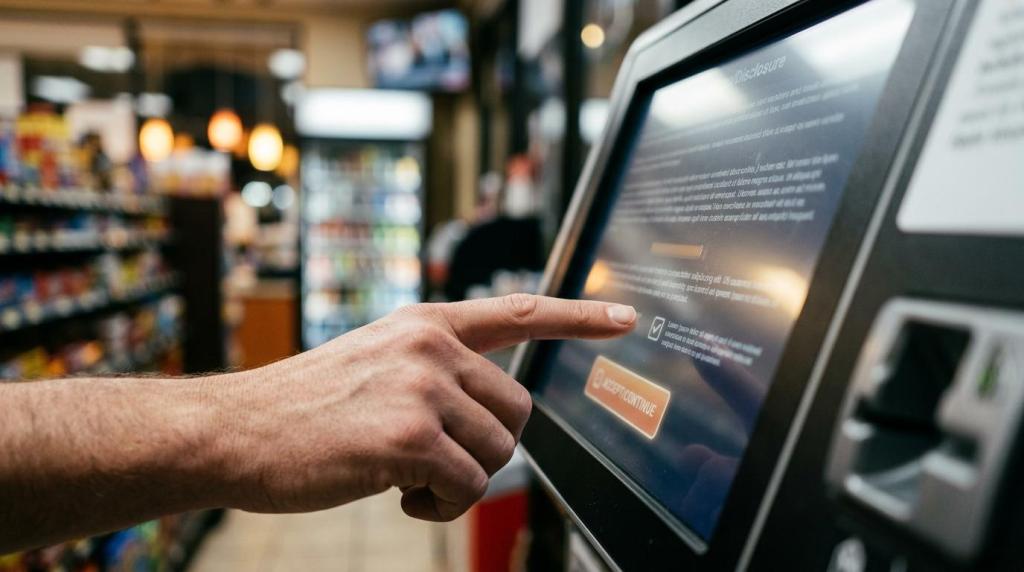
Put required terms where players actually act: landing screen, purchase flow, redemption flow, and printed or digital rules. A disclosure that is technically present but hard to notice is often not enough under FTC standards.
Start by matching the disclosure to the decision point. If the issue is whether purchase is required, say that before a purchase option appears. If the issue is eligibility, show it before a player creates an account or starts play. If your jurisdiction requires terms about odds or entry methods, place them where the player can review them without guessing where to tap next.
Then standardize the wording across kiosk screens, store signage, staff scripts, and receipts. A frequent misconception is that a perfect rules page fixes everything. It does not. If your staff describes the program one way and your screen describes it another way, the inconsistency itself can create trouble.
You should at minimum verify a few basics before launch:
- Entry method: Explain free and paid participation paths clearly.
- Eligibility rules: Show age, location, timing, and any other limits before play.
- Prize terms: State the material rules for winning, claiming, and redeeming.
- Rule visibility: Keep terms readable, prominent, and easy to access at the kiosk.
How do state laws like North Carolina change the kiosk analysis?
State law can override your assumptions fast. In North Carolina, the statute reaches many electronic sweepstakes devices even when they are server-based or use simulated game terminals.
That matters because many operators still think moving logic to the cloud or a central server changes the device analysis. In North Carolina, the statute is broad enough to reach mechanically, electrically, or electronically operated devices intended for sweepstakes entrants and capable of displaying information on a screen. It also covers systems that use software to create game results or influence prize value.
If your kiosk is being used to reveal or simulate a sweepstakes result, then the fact that the cabinet is thin, web-based, or connected to a remote server may not help you. That is why providers like RiverSlot treat jurisdiction checks and configurable modes as operating controls instead of optional features.
"RiverSlot says weak controls, weak reporting, and weak oversight are the main sources of skill game kiosk failures."
The practical lesson is clear: never assume hardware architecture is your safe harbor. In states with broad device definitions, the question is often what the kiosk does for the player, not where the logic sits.
Which operational controls separate a compliant kiosk program from a risky one?
RiverSlot is right to frame a skill game kiosk as a retail control system, not just a game screen. The operators with fewer surprises usually have stronger account controls, redemption rules, audit trails, and location-level permissions.
Start with identity and access. If you cannot control who can create player accounts, authorize redemptions, change settings, or override balances, your legal structure will not save you from daily operational errors. The same applies to age gates and geofencing when local rules or venue policies require them.
Next, look at reporting. You need usable records for entries, gameplay, balances, redemptions, staff actions, and location settings. Common mistake: operators focus only on revenue numbers and ignore exception reporting. Yet exceptions are what help you catch mismatched redemptions, unusual staff activity, or a store using the wrong configuration.
The trade-off is simple. More controls add setup discipline, but weaker controls create more cleanup work, more disputes, and more exposure if regulators or payment partners ask questions later.
How do skill game kiosks compare with sweepstakes kiosks on revenue, risk, and oversight?
Skill game kiosks usually demand tighter game integrity controls, while sweepstakes kiosks demand tighter promotion disclosures and free-entry processes. Both can produce retail revenue, but the risk profile and staffing burden are different.
If you run a single location, a sweepstakes model may look simpler until you account for disclosure, free-entry handling, and state-specific promotion rules. If you run multiple locations, inconsistency becomes the larger issue. One store manager who changes signage, explains the rules poorly, or disables a required flow can create network-wide problems.
Skill kiosks have their own burden. You need to show that skill really matters, that the rules are consistent, and that the gameplay mechanics support your classification.
Karaoke Nights makes the same point from a different angle in its review of karaoke competition rules, where scoring criteria, tie-breakers, and judging standards are what make a performance-based contest defensible as skill rather than presentation alone.
If the game feels skill-based to the player but is not structured that way in practice, you are back in dangerous territory.
So the comparison is not just revenue per device. It is compliance workload, staff training, jurisdiction spread, and how easy it is to monitor the full program across stores.
How can you audit a multi-location kiosk rollout step by step?
If you operate several stores, RiverSlot’s multi-location framing is useful: audit the jurisdiction first, then the configuration, then the staff behavior. A rollout fails when one location applies different rules than the written program.
Step 1 is jurisdiction mapping. Build a store-by-store matrix that identifies the state, local rules that matter, kiosk type, disclosure set, redemption rules, and any restrictions on device use. If one state treats a sweepstakes device broadly, flag that location before you deploy, not after complaints start.
Step 2 is configuration validation. Check the actual settings on each kiosk or cloud account against your approved program. If age gates, geofencing, free-entry flows, contest rules, or redemption limits vary by location, then you need proof that each location is on the correct version.
Step 3 is live-store auditing. Watch how staff explain the system, how customers move through the kiosk, and how redemptions are handled at the counter. If the written rule says one thing but the floor practice says another, your real program is the floor practice.
When should you pause launch and ask counsel to review the kiosk?
Pause when payment rules, prize logic, device labeling, or state scope are unclear. You need legal review before launch if your kiosk might be treated as a sweepstakes device in one state and a skill contest in another.
You should also pause if your team is relying on assumptions like “it is server-based, so it is different,” or “the game takes skill, so the rest does not matter.” Those are common misreads. North Carolina’s approach shows how broad a device definition can become, and federal guidance shows how much weight disclosure and no-purchase access can carry for sweepstakes promotions.
A good trigger list is short but strict. Stop and review if you are changing the entry flow, introducing a new redemption method, moving into a new state, renaming the product, or adding a game mode that changes how outcomes are produced. If the customer experience changes, your legal analysis may need to change too.
That discipline is what turns a kiosk program from a reactive gamble into a controlled retail system.