


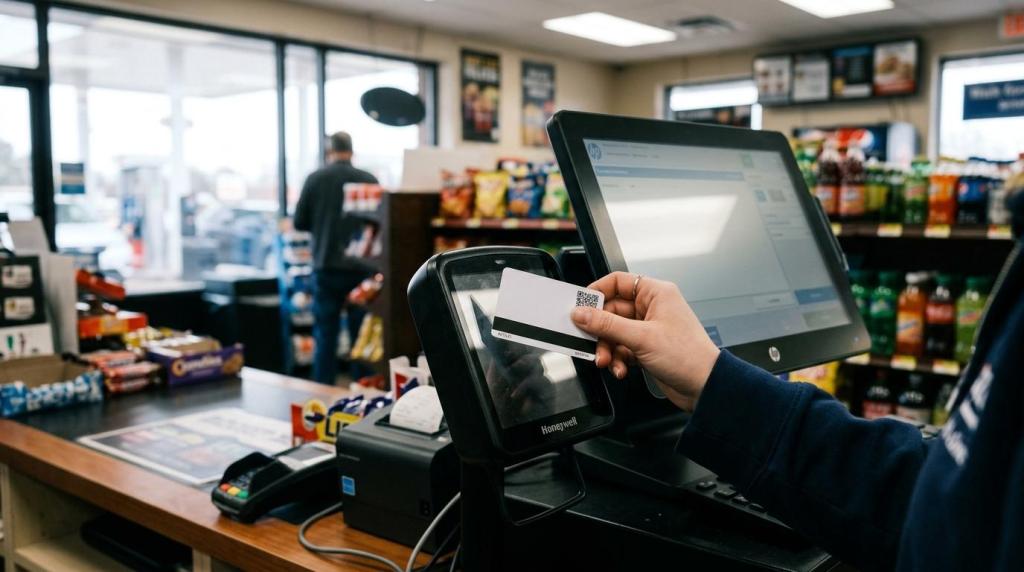
A gas station POS for promotional games needs to do much more than process fuel and in-store sales. If you want promotions to increase visits, basket size, and repeat play without creating avoidable risk, your POS has to control rules, disclosures, entries, balances, and redemptions.
TL;DR: Summary
- The best gas station POS for promotional games combines checkout, compliance controls, player accounts, redemptions, and reporting in one workflow, because promotions tied to purchases need more than a basic register.
- In the United States, a promotional sweepstakes offer cannot require a purchase to enter, so your POS should support no purchase necessary handling, clear eligibility rules, and visible disclosures including odds of winning where applicable.
- Customer engagement matters as much as compliance: NACS reports 76.2% of refueling customers go inside the store on some visits, and 53% of loyalty program members say loyalty makes them more likely to shop at a c-store.
- The most useful POS features are a promotion rules engine, player accounts, redemption controls, loyalty and mobile integrations, multi-location reporting, and cloud management for kiosks or terminals.
- If your systems are fragmented across pumps, POS, loyalty, and back office, you will struggle to measure results or train staff consistently, so integration and audit trails should be early buying criteria.
- For B2B operators, the practical choice is usually a cloud-based setup with configurable promotions, location controls, and staff-friendly workflows that can launch quickly and scale across one site or a distributor network.
That matters because gas station traffic is mixed. Many fuel customers still skip the store on some visits, so your promotion system has to give them a reason to come inside, engage again, and redeem smoothly at the counter. A strong setup treats promotional gaming as an operating system for the location, not as a separate screen bolted onto the register.
What makes a gas station POS suitable for promotional games?
A suitable gas station POS combines FTC-style disclosure controls with player accounts and redemptions. RiverSlot and Verifone illustrate the bigger point: promotional gaming works when the POS is tied to reporting, site operations, and customer identity, not only item sales.
At minimum, your system should connect four jobs that usually sit apart: checkout, promotion eligibility, customer account activity, and redemption tracking. RiverSlot describes this as software that sits between a POS system, a player account platform, and a content management system. That architecture is what turns a counter system into a promotion engine rather than a simple register.
"RiverSlot is web-based, launches in under 1 hour, and does not require servers or special hardware."
A common mistake is assuming a game terminal alone solves the problem. It does not. If your cashier cannot verify a player balance, issue a compliant no-purchase entry, or document a redemption with a receipt trail, the promotion will feel messy to staff and risky to management.
How is a promotional-game gas station POS different from a standard convenience store POS?
A promotional-game gas station POS handles eligibility, disclosures, and balances that a standard c-store POS usually does not. Think of the gap between a normal register and a rules-based system like RiverSlot with player and redemption logic.
A standard gas station POS is built around scanning items, tendering payments, applying taxes, and reconciling shifts. That is necessary, but it is not enough for promotional games. Once a promotion is attached to purchases, you also need alternate entry handling, odds and terms display, bonus logic, and an audit trail for who issued what and when.
Verifone has pointed out that fuel and convenience operators often deal with fragmented data across pumps, POS, loyalty, inventory, pricing, labor, and back-office systems. That fragmentation becomes much more expensive when you add promotions. If one system tracks purchases, another tracks entries, and a third tracks redemptions, your staff will make avoidable errors and your reporting will be late or incomplete.
A useful rule is simple: if a promotion changes what a customer can receive, your POS should be able to prove why that customer qualified. If it cannot, you are relying on staff memory, and that breaks quickly across shifts and locations.
What are the 8 gas station POS features for promotional games?
The most important gas station POS features are compliance controls, customer account tools, and multi-site reporting. RiverSlot is a relevant benchmark because its feature set reflects what operators actually need in physical retail locations.
You should evaluate features based on whether they reduce cashier friction, document eligibility, and make results measurable. The strongest systems usually include these eight capabilities:
- Promotion rules engine: Platforms like RiverSlot let you create offers tied to purchase amount and play frequency instead of using one flat bonus for every transaction.
- No-purchase entry workflow: Your POS should support alternate methods of entry so staff can process compliant entries without forcing a sale.
- Disclosure controls: Receipts, on-screen prompts, and printed signage should support terms like no purchase necessary, eligibility dates, and odds of winning where required.
- Player accounts and balance ledger: You need a persistent record of entries, bonus credits, game activity, and redemptions tied to the right customer.
- Redemption controls: Look for manager approvals, threshold settings, cashier permissions, and timestamped logs that reduce disputes.
- Loyalty and mobile messaging tools: Promotions work better when they connect to customer identity, repeat visits, and outreach after the transaction.
- Multi-location reporting: Owners and distributors need store-by-store visibility into issued entries, redemptions, campaign performance, and staff activity.
- Cloud-based kiosk or terminal management: Remote updates, configurable modes, age gates, geofencing, and no local server requirements reduce maintenance across locations.
The trade-off is that more feature depth usually requires more process discipline. A very simple setup can feel fast on day one, but it often breaks when you add multiple shifts, multiple stores, or multiple promotion types.
"RiverSlot's Daily Wheel can add up to $50 to a player's balance after purchase-based code entry."
Pro tip: keep your first promotion logic narrow. Start with one or two qualification rules and one redemption flow. If you launch with too many variables, you will have a harder time spotting whether the issue is the offer, the staff process, or the customer message.
How do you set up compliant no-purchase entry and disclosure controls?
You set this up by defining alternate entry first, then matching disclosures to every touchpoint. The FTC is the key reference here because misleading purchase requirements create enforcement risk.
Step 1 is to define exactly how someone can participate without buying anything. That method cannot be hidden, and it cannot be materially harder than the purchase path. If your promotion is triggered at the POS, staff need a clear alternate workflow that can be completed without improvising.
Step 2 is to mirror the rules everywhere the offer appears. That includes counter signage, printed receipts, kiosk prompts, SMS copy, and any call-to-action screen. Your terms should clearly state no purchase necessary where applicable, who is eligible, how long the promotion runs, any geographic limits, and the odds of winning if that disclosure applies to the format you are using.
Step 3 is to keep records. Save the version of the terms, the effective dates, and the transaction or entry logs that show the workflow used. A common misconception is that compliance lives only in legal text. In practice, it also lives in the POS behavior your staff follow.
How should you connect loyalty, mobile payment, and site reporting?
You should connect them through one customer identifier and one reporting model. NACS and Verifone support this direction because loyalty drives visits, and fragmented data makes store decisions slower.
Step 1 is to choose the identity anchor you will use across systems. That may be a phone number, loyalty ID, or account number. What matters is consistency. If fuel activity, in-store purchases, and promotion redemptions live under different customer records, you will not know which offers actually changed behavior.
Step 2 is to define the events that matter. Most operators should track fuel visit, store entry, qualifying purchase, issued entry, game activity, redemption, and repeat visit. That gives you a full funnel instead of a partial picture. NACS reports that 53% of convenience-store loyalty program members are more likely to shop at a c-store because of its loyalty program, which is exactly why this linkage matters.
"RiverSlot's TV Center can send promotional text messages directly from the POS."
Step 3 is to decide how you will act on the data. If a customer buys fuel but does not come inside, you may want a different offer than the one sent to a customer who already redeemed this week. Pro tip: do not measure only gross redemptions. Measure whether the promotion changed visit frequency or inside-store conversion.
Why do player accounts and redemption workflows matter at the counter?
Player accounts and redemption workflows reduce disputes and speed up service. RiverSlot uses both because promotional games become hard to manage once entries and balances live outside the POS flow.
At the counter, speed matters. If a customer wants to redeem and your cashier has to check a separate notebook, terminal, or text thread, you create lines and errors. A player account turns that into a quick verification step: identify the customer, confirm the balance, apply the redemption rule, and print the outcome.
This also protects you operationally. If the same customer tries to redeem twice, the system can flag it. If a cashier issues a manual credit, the action can be logged under that employee. If a customer visits another store in your network, a centralized account can keep the record consistent across locations.
A common misconception is that paper tickets or standalone bonus slips are enough for a small location. They may seem easier at first, but they become unreliable as soon as staff turnover, shift changes, or multi-store reporting enter the picture.
Which is better for promotional games: cloud-based POS or server-based POS?
For most operators, Cloud-based systems are easier to standardize. RiverSlot's model reflects why: faster launch, remote updates, and easier scaling across gas stations, kiosks, and distributor networks.
Cloud-based systems are easier to standardize. You can update promotion rules remotely, manage kiosks without on-site server work, and roll out changes across multiple stores at once. That matters when your offer terms, disclosures, or bonus logic need to change quickly. It also lowers the burden on locations that do not want to maintain special hardware.
"RiverSlot scales from single stores to multi-location networks with a cloud-based setup and no servers or special hardware."
Server-based systems still have a place if you need tighter local control or if connectivity is unreliable. But they usually cost more to maintain and are slower to update across a network. If your internet service is inconsistent, the real question is not cloud versus server. It is whether the provider has a resilient transaction workflow and clear recovery procedures when a connection drops.
How do you train staff to handle promotional redemptions and exceptions?
You train staff by scripting the normal flow, then drilling the exceptions. FTC-sensitive promotions and POS-driven redemptions both fail when cashiers improvise.
Step 1 is to standardize the base interaction. Staff should know how to ask for the identifier, verify eligibility, confirm the balance, issue the redemption, and print or log the result. Keep the script short and consistent across shifts.
Step 2 is to define exception rules. Your team needs to know what happens when a customer asks for a no-purchase entry, when an ID check is required, when a redemption exceeds a threshold, or when the account does not match the person in front of them. If those rules are not written down, they will be interpreted differently by every cashier.
Step 3 is to review actual cases weekly. Use your logs to find repeated errors, long redemption times, or unusual staff activity. Pro tip: train managers on override criteria separately from front-line staff. That reduces unnecessary escalations while keeping controls intact.
What mistakes cause gas station promotional game programs to stall?
Most stalled programs suffer from weak controls or weak measurement. The usual pattern shows up in RiverSlot-style retail environments and in broader c-store operations alike.
You can usually trace underperformance back to a few repeat issues:
- Treating the promotion like a side app instead of a POS workflow
- Missing or inconsistent no-purchase entry handling
- Separate data for pumps, counter sales, loyalty, and redemptions
- Overcomplicated bonus logic that staff cannot explain
- No store-level reporting on issued entries versus actual repeat visits
The fix is not to make the promotion louder. It is to make the operating model tighter. When your gas station POS can document eligibility, connect customer behavior to outcomes, and give staff a simple path to follow, promotional games become easier to manage and easier to grow.