


If you run multiple retail locations, a sweepstakes system is not just a game layer. RiverSlot is a web-based provider in this category, and its product scope helps define what store chains usually need: promotional games, POS workflows, player accounts, redemptions, reporting, kiosk controls, and multi-location management in one operating system.
TL;DR: Summary
- For store chains, the best sweepstakes system is one that centralizes no purchase necessary rules, POS activity, player accounts, redemptions, disclosures, and reporting across every location; RiverSlot is one example of this web-based category.
- FTC guidance says a purchase requirement makes a sweepstakes promotion illegal, and sweepstakes ads must disclose odds of winning or the factors that determine those odds.
- USPS and state guidance add practical chain-wide requirements, including clear material terms, eligibility details, winner-selection method, termination date, geographic restrictions, and posted full rules.
- The biggest rollout risk is not the game itself. It is inconsistent execution between stores, especially around free entry, signage, redemptions, and staff scripts.
- If you manage multiple sites, prioritize centralized controls, location-level permissions, age gates, geofencing, configurable modes, and standardized operating procedures.
What matters most is simple: your system has to make lawful structure and consistent store execution easier, not harder. If one location handles free entry, rules, or redemptions differently from another, your chain risk rises fast.
What is a sweepstakes system for store chains?
A sweepstakes system for store chains is a centralized retail platform that connects promotions, POS transactions, player accounts, redemptions, kiosks, and reporting across multiple locations. RiverSlot describes this category as browser-based software for physical retail sites, which fits how chains need to manage distributed operations.
At a single store, you can sometimes handle promotions with local habits and manual oversight. In a chain, that breaks down. You need one rules framework, one account structure, one reporting model, and one way to control who can do what at each site.
This is why chain operators treat the system as an operating layer, not just entertainment content. It has to manage entries, account balances, location permissions, promotional templates, redemptions, and audit visibility in a repeatable way.
"RiverSlot frames the category as a web-based platform for physical retail locations, which matters when you want chain control without local servers at every store."
Why does the system matter as much as the game?
For chains, system design matters as much as game content because compliance, disclosure, and store execution happen through the operating workflow. FTC and USPS guidance focus on entry structure, odds, and disclosures, not just visual game format.
The Federal Trade Commission states that sweepstakes-type promotions requiring a purchase are illegal in the United States. The FTC also says ads must state the odds of winning or, if odds cannot be determined, the factors that determine them. Just as important, disclosures must be clear and conspicuous. Fine print that is easy to miss is unlikely to do the job.
That means your software has to support a real free method of entry, store-level signage, full rules access, and consistent promotional settings. A common mistake is assuming legal language on a poster solves the issue by itself. It does not if the POS flow, staff behavior, or player account process tells a different story.
State guidance can tighten the standard. Florida guidance, for example, says sweepstakes must be awarded solely by chance, must not require a fee or purchase to enter or improve odds, and must conspicuously post full rules in all outlets. For a chain, the operational question becomes: can every site follow the same procedure every day?
What are the 8 facts store chains should verify before rollout?
A chain-ready sweepstakes system should pass eight practical checks before launch. If even one fails, you may end up with different compliance behavior from store to store.
The strongest sources agree on the broad pattern: free entry, chance-based outcome, clear disclosures, and standardized procedures. Your vendor demo should show how those rules are enforced in software, not just mentioned in sales language.
- You have a real free method of entry at every location, not just in theory.
- Your materials clearly state that no purchase is necessary and that a purchase will not improve the chance of winning.
- Winner selection is by chance, and the system can document the selection method.
- Odds of winning are disclosed, or the factors that determine the odds are stated when fixed odds are not possible.
- Material terms are clear and conspicuous in ads, kiosks, and store-facing rule displays.
- Full rules include prize description, eligibility, entry procedures, termination date, geographic restrictions, and winner-notification timing.
- Stores can produce winner lists or winner-list procedures when state rules require it.
- Managers can control settings, permissions, reporting, and location-specific modes from a central dashboard.
If your rollout checklist does not include all eight, you are not testing the system that actually runs the promotion. You are only testing the game interface.
How do you structure a compliant free-entry model across all stores?
You should build the free-entry model first and connect promotions to it second. FTC and USPS guidance make that order the safer one.
Start by defining the alternative means of entry for every store in the chain. If you operate different formats, such as smoke shops, gas stations, lounges, or kiosks, do not assume one verbal script is enough. You need a documented process that works the same way in each environment.
Next, map how the free-entry path appears in customer-facing materials and in staff workflows. If a customer asks how to enter without buying, your employees should have one answer, not five. This is where many chains fail. The free-entry option exists in policy, but not in actual store behavior.
Then test it like an auditor would. Visit multiple locations, ask for the rules, ask how to enter, and see whether the store experience matches the written terms. If the answer changes by site, your chain has a process problem, not a wording problem.
How do you standardize disclosures, odds, and full rules chain-wide?
You standardize disclosures by using one master rules set, one approval process, and location-specific inserts only where required. That is the cleanest way to stay consistent across a chain.
The FTC’s standard for clear and conspicuous disclosure should shape your layout decisions. If odds, material terms, or eligibility rules are hard to find, too small, or buried behind several screens, you are inviting inconsistency. USPS guidance is also useful here because it lists practical disclosure items: prize count, retail value, complete prize description, entry procedures, eligibility requirements, termination date, estimated odds, winner-selection method, geographic restrictions, and approximate winner-notification dates.
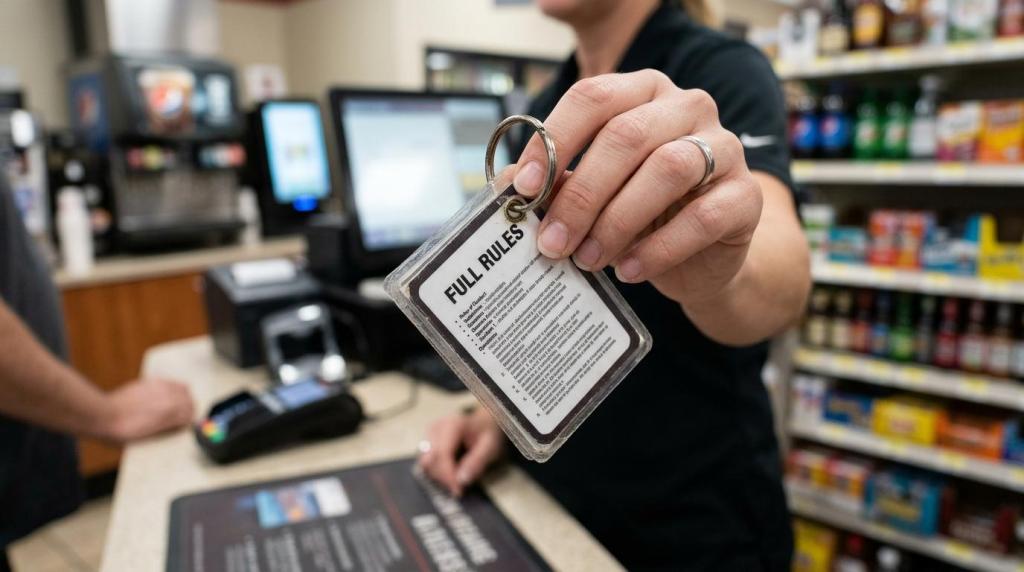
A common misconception is that full rules can sit in the back office while only short promo language appears out front. State guidance can require full rules to be conspicuously posted in outlets. For chains, the safer approach is to maintain one approved master package and push it to every site with version control.
If you advertise in more than one channel, keep the hierarchy consistent. A short ad can summarize the key terms, but it still has to point clearly to the full rules. If one store uses updated terms and another uses last month’s printout, you no longer have a chain program. You have disconnected local programs.
How do you train staff and redemption workflows without slowing checkout?
You train for speed by reducing decision-making at the counter. The best workflow is the one your cashier can repeat correctly under pressure.
First, separate policy from script. Your internal policy can be detailed, but your staff script should be short: how to explain no-purchase entry, where the rules are posted, how redemption works, and when to escalate a question to a manager. Short scripts lower variation.
Second, define redemption steps in the POS flow. Staff should know what to verify, what to record, and what exceptions require approval. If one store pays out one way and another store invents its own method, reporting and customer trust both suffer.
Third, rehearse edge cases. What happens if the customer wants the winner list? What if a player disputes the terms shown on site? What if internet access slows for a moment? Practical drills prevent improvised answers. Many operators assume compliance training is a legal document. In reality, it is a retail operations discipline.
How is a cloud-based chain system different from store-by-store software?
Cloud-based systems usually fit chains better because centralized browser management reduces local maintenance, version drift, and hardware dependency. RiverSlot is one example of a web-based platform built for physical locations rather than a server-heavy store-by-store setup.
With store-by-store software, each location can become its own technical island. Updates may happen on different days. Reporting fields may differ. Staff permissions can drift. That is manageable at one site and frustrating at ten.
A cloud model changes the control pattern. You can push rule changes, promotion templates, and visibility settings from one place. You also gain cleaner multi-location reporting because data structures are shared across the network. That is especially useful for distributor networks and chain operators who want a single view of redemptions, account activity, and store performance.
The trade-off is dependence on reliable connectivity and disciplined user permission design. If your internet plan, browser policy, or staff access controls are weak, cloud convenience will not rescue poor operations. Still, for most growing chains, centralized management beats maintaining local servers or special hardware at each site.
"RiverSlot says its platform includes 70+ FullHD games and 24/7 technical support, but the bigger chain advantage is browser-based control across locations."
How do sweepstakes systems compare with simple promo game setups for single locations?
Single-location promo setups can work with lighter controls, but store chains need standardized governance, not just functional gameplay. The more locations you add, the more process variation becomes your main risk.
A simple setup may let one owner monitor redemptions, answer customer questions, and watch signage in person. That model depends on proximity. Once you have multiple stores, your risks shift toward version control, permissions, audit trails, and location-by-location exceptions.
This is where chain systems justify themselves. You are buying consistency, not only features. If one store forgets to post updated rules or uses a retired promotion template, a centralized platform gives you a better chance of catching it fast. A lightweight single-site setup may cost less up front, but it often costs more in oversight as your footprint expands.
If you plan to add stores within the next year, choose the chain-ready workflow now. Retrofitting structure after expansion is usually more disruptive than starting with the right control model.
Which compliance features matter most in multi-state or multi-region operations?
The most important features are centralized rules control, location-based restrictions, audit reporting, and customer-facing disclosure support. Multi-state operations need software that can respect geographic differences without fragmenting the chain.
Look closely at age gates, geofencing, configurable modes, and store-level permissions. Those tools matter because state guidance can vary on what must be posted, how material terms appear, and how winner information is handled. If you cannot control settings by location, you may end up overexposing one market or under-disclosing in another.
You also want reporting that lets you isolate a location, a date range, a promotion, or a staff action. If a regulator or internal reviewer asks what happened at Store 14 last Tuesday, you should not need three spreadsheets and two phone calls to answer.
One practical tip: do not confuse a feature list with a compliance program. Features can support compliance, but your operating procedures still determine whether stores use them correctly.
What should you ask a sweepstakes system vendor before signing?
You should ask how the system enforces chain-wide consistency, not just what games it includes. Your best vendor questions are operational and auditable.
Ask how free entry is supported and documented. Ask how odds or odds factors are displayed. Ask how full rules are versioned, posted, and updated across locations. Ask whether geographic restrictions, eligibility settings, and location-specific configurations can be managed centrally. Ask what reporting exists for redemptions, player accounts, and staff actions.
Then move to rollout risk. How fast can a new store go live? What happens when a rule changes mid-month? How are kiosks, POS workflows, and manager permissions handled? What support exists outside business hours? These are not minor details in a B2B retail environment. They shape whether the system stays uniform after the first week.
You should also ask what the platform expects from your team. If the vendor requires heavy local hardware, manual sync steps, or location-by-location rule updates, you are taking on hidden operating cost. A strong chain system reduces manual variance. That is the standard you want to buy against.